First edition
English
Literary science fiction · illustrated eBook · target 200–300 pages
$19
A novel of civilizations, memory, and consequence
Every civilization believes it is the first to reach the edge. Someone has always been waiting there.
AIThis fictional story was generated with artificial intelligence.
The premise
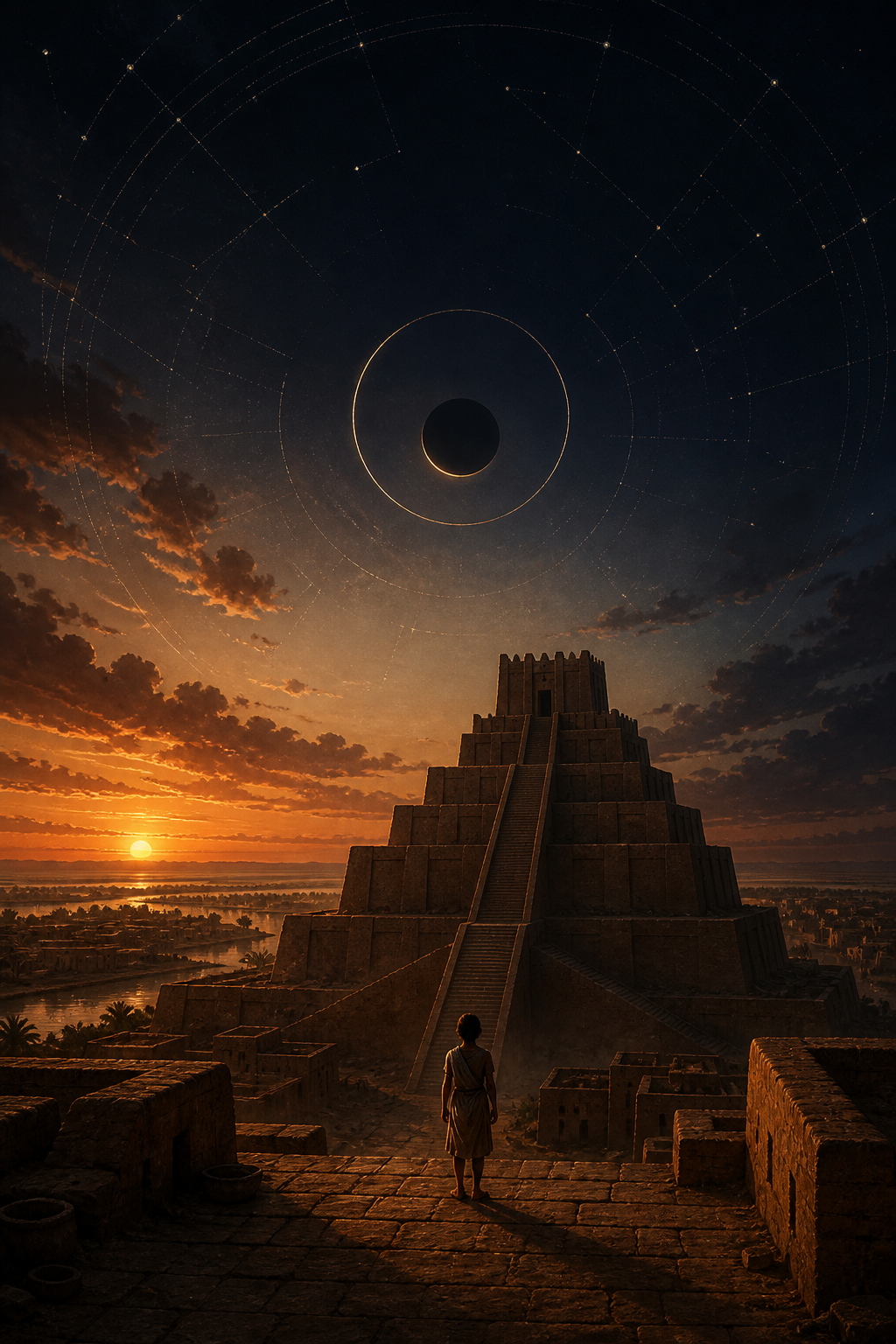
Across the first cities, drowned libraries, broken empires, and settlements not yet built, the Anunna observe one recurring experiment: what humans do when survival depends on one another—and power offers a different answer.
A scribe at the birth of writing and a chronologist in a climate-altered future discover the same impossible mark. Following it means crossing the ruins of civilizations and asking whether a guardian can witness suffering without becoming its cause.
The speculative science
The novel treats backward time travel as unproven physics. Its central mechanism draws on closed timelike curves, causal self-consistency, information loops, and the human habit of interpreting unfamiliar technology as divine authority.
The editions
The English edition is the source text. Modern-language editions are literary translations. The Sumerian experiment is a short, annotated adaptation—not a claim of an authentic ancient manuscript.
Literary science fiction · illustrated eBook · target 200–300 pages
𒀭 𒀀 𒉣 𒈾
Secure card payment. Your private download link appears immediately after purchase, and you can set a password to keep a permanent reader account with access to the Explorer's Room.
Opening tablet · 01
“Before the city learned to remember, it learned to count what it feared losing.”
Ninmada pressed the reed into wet clay and made a mark no one had taught her. Beyond the wall, the river had begun to rise without rain.
The reader list
New editions, translations and behind-the-work notes on The Modern Myth — occasional, never resold.
One list, no spam. Unsubscribe any time.
A note on the name
In surviving Mesopotamian texts, Anunna/Anunnaki names a changing group of deities associated with high status, fate, and—in some later traditions—judgment in the underworld. The novel transforms that historical term into a fictional guardian role. That transformation belongs to the story, not to archaeology.
Read the scholarly overview at ORACC ↗Radical transparency
The narrative, translations, cover art, and website use generative AI under human direction and editorial review. Every paid edition repeats this disclosure on its cover page and copyright page. No edition will be sold as a recovered tablet, secret history, or scholarly Sumerian translation.
The record remains open
Enter the first city. Follow the mark. Decide what a guardian owes the people it watches.
Explore editionsThe Modern Myth · Fictional universe · AI-generated and editorially directed