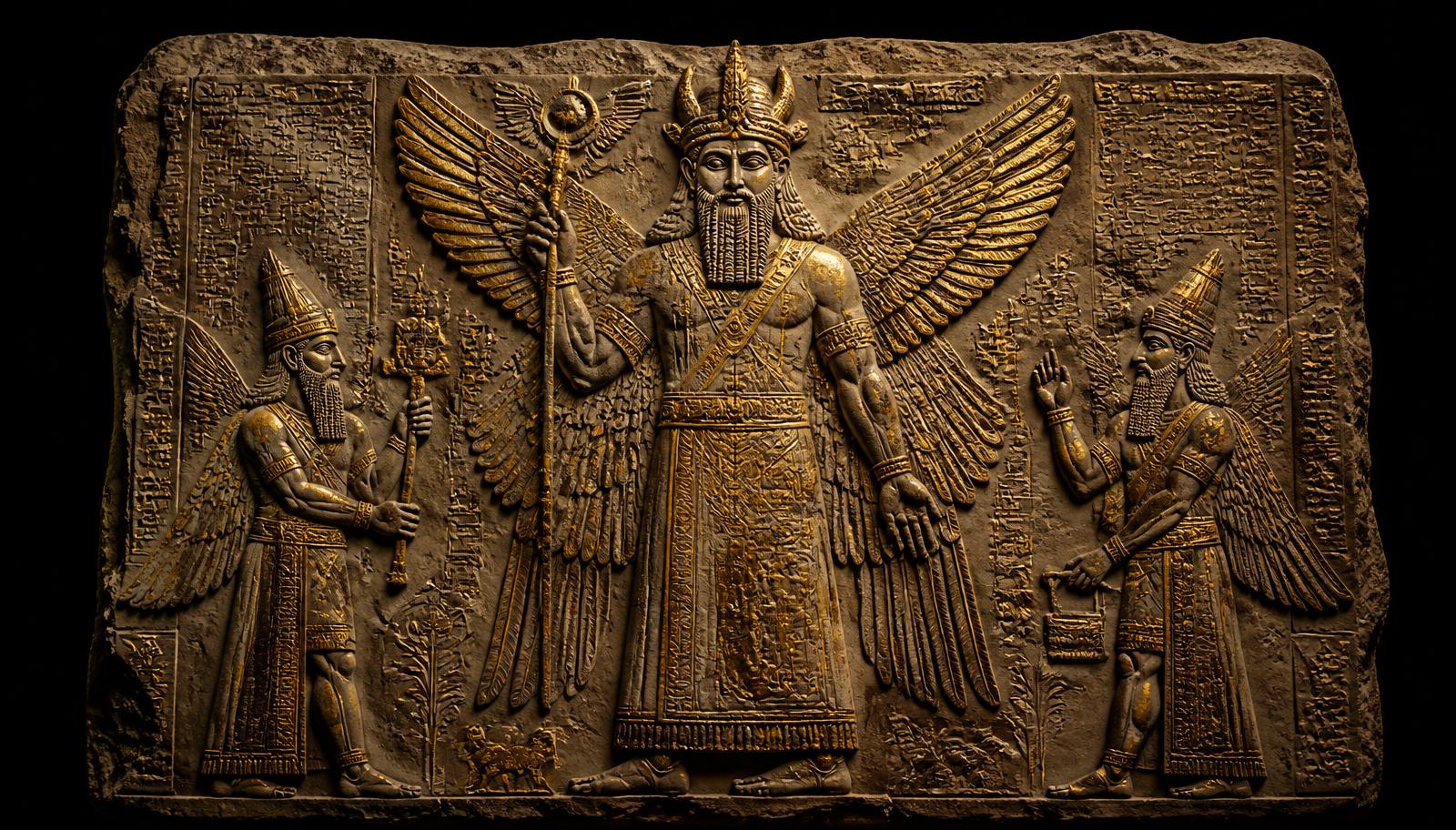
Those who from heaven came to earth
The Anunnaki
In the oldest written stories on earth, a company of gods divides the sky, the air and the underworld between them — and decides what to do about humankind.
ENTER THE PANTHEONThe name
A word before it was a myth
Sumerian scribes wrote a-nun-na — "the princely offspring" — and later a-nun-na-ki, binding those princes to ki, the earth. The word is collective, not personal: it names a council rather than a single god, the assembly of the great deities descended from An, lord of the sky.
Across two thousand years the term drifted. In some texts the Anunnaki rule the heavens beside the Igigi; in others they are judges of the dead, seated in the dark house of Ereshkigal where dust lies on the door.
A rough chronology
Six turns in the story
c. 3200 BCE
Writing begins at Uruk
Accountancy on clay turns into a script capable of carrying myth.
The first tablets from Uruk are ledgers: barley, sheep, beer, the names of officials. Within a few centuries the same wedge-shaped marks can record verbs, and the temple archives begin to hold more than inventories. Everything later known about the Anunnaki depends on this accident — that a bookkeeping system grew flexible enough to write down what people believed.
- City
- Uruk, on the old course of the Euphrates
- Script
- Proto-cuneiform, pictographic
- Surviving tablets
- Several thousand, mostly economic
"When the gods instead of man did work, bore the loads, the gods' load was too great, the work too hard, the trouble too much."
Atrahasis, Tablet I